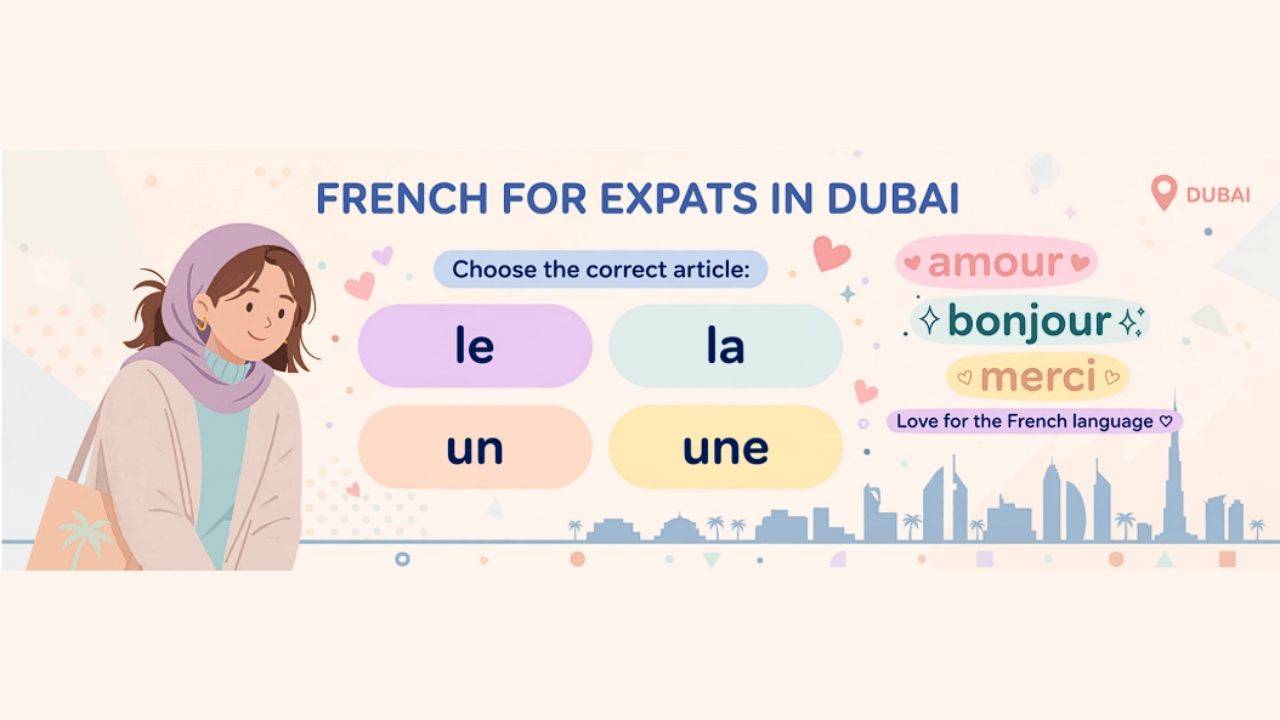
Articles in French: Definite, Indefinite and Partitive Explained
Sep 23, 2026
Published September 23, 2026 · 9 min read
Living in Dubai, Abu Dhabi or Sharjah, you hear French everywhere : at the bakery in Al Wasl, at the Louvre Abu Dhabi, or when ordering your morning karak. But when you start learning French, a few small words keep coming back : le, la, un, du… These little words are French articles, and they are essential.
If you are an expat learning French in the UAE, this comprehensive guide is for you. We will make articles simple, clear and practical, with real-life examples from your life in the Emirates.
What are articles in French?
In French, an article is a small word that comes before a noun. Just like in English we say « a coffee » or « the coffee », in French you cannot say the noun alone. You always need an article.
Compare :
- English : Coffee is delicious. (no article)
- French : Le café est délicieux. (you need an article)
Articles in French do two very important jobs :
- They show if we are talking about something specific or general.
- They tell us the gender (masculine or feminine) and the number (singular or plural) of the noun.
This is why you can’t ignore them. In French, every noun has a gender, and learning the article with the noun is the best way to remember it. Don’t learn voiture (car), learn la voiture.
The three main types of articles in French
There are only three families of articles to know. Once you know them, you know 90% of the system.
1. Definite articles (les articles définis) : le, la, l’, les
We use them for something specific, known or unique. Like « the » in English.
2. Indefinite articles (les articles indéfinis) : un, une, des
We use them for something general, not yet known, or to count. Like « a, an » and « some » in English.
3. Partitive articles (les articles partitifs) : du, de la, de l’, des
This is the very French one. We use it for an unspecified quantity, something you cannot count. Like « some », or no article at all, in English.
Good news : you don’t need to memorize anything else. Every article you will see in French belongs to one of these three groups.
How French articles agree with gender and number
This is the golden rule for all expat learners : in French, the article must agree with the noun. It changes depending on whether the noun is masculine or feminine, singular or plural.
Here is the complete table to keep :
| Masculine singular | Feminine singular | Before a vowel / silent h | Plural (both genders) | |
|---|---|---|---|---|
| Definite | le café | la plage | l’ami / l’école | les cafés / les plages |
| Indefinite | un café | une plage | un ami / une école | des cafés / des plages |
| Partitive | du café | de la salade | de l’eau | des pâtes |
Partitive des looks exactly like indefinite des : the context tells you the meaning.
Two essential rules for beginners :
- Le / La becomes L’ before a vowel. We do this for pronunciation. You don’t say le ami, you say l’ami. You don’t say la eau, you say l’eau. Very common in Dubai when you talk about water !
- Feminine is often, but not always, -e. There is no perfect rule, so always learn the noun WITH its article. La voiture is feminine, le métro is masculine. Your French brain will thank you later.
When to use definite articles in French
Use le, la, l’, les when you talk about something specific, unique, or already known to both speakers.
1. For something specific or already mentioned
- J’ai acheté une voiture. La voiture est rouge. (I bought a car. The car is red.)
2. For general truths and concepts
- J’aime le café. (I like coffee, in general.)
- La patience est importante. (Patience is important.)
This is a big difference from English. In English you say « I like coffee » with no article. In French, you must say J’aime le café.
3. For unique things
- le soleil, la lune, le ciel (there is only one sun)
4. For habits, likes and dislikes with aimer, adorer, détester, préférer
- J’adore les plages de Dubaï. (I love the beaches of Dubai.)
- Je déteste le bruit du trafic sur Sheikh Zayed Road. (I hate the traffic noise on Sheikh Zayed Road.)
UAE example : Le Dubai Mall est grand. We know which mall, it’s specific.
Still hesitating between le, un and du ?
Book a free trial class with Murielle and turn French articles into a reflex, with examples from your own life in Dubai.
Book my free trial class →When to use indefinite articles in French
Use un, une, des when you talk about something for the first time, something not specific, or when you count. Think of it as « one / some ».
1. To introduce something new
- Il y a un restaurant français à JLT. (There is a French restaurant in JLT. We mention it for the first time.)
- J’ai une amie émiratie. (I have an Emirati friend.)
2. To count
- Je veux un karak, s’il vous plaît. (I want one karak, please.)
- Elle a acheté des dattes au souk. (She bought some dates at the souk.)
Quick decision for expats : is it your first time mentioning it ? Use un / une / des. Is it already known ? Switch to le / la / les.
Un café (a coffee, any coffee) → le café (the specific coffee we talked about).
How partitive articles work in French
This is the article French learners in the UAE ask about most. We use partitive articles du, de la, de l’, des for things you cannot count or for an unspecified quantity : food, drink, abstract ideas.
In English, you often say nothing : « I drink water. » In French, you must say « some ».
1. For food and drink
- Je bois du café le matin. (I drink coffee in the morning.)
- Elle mange de la salade. (She eats salad.)
- Nous buvons de l’eau. (We drink water.)
- Tu veux des frites avec ton shawarma ? (Do you want some fries with your shawarma?)
2. For abstract quantities or feelings
- Il a du courage. (He has courage.)
- Il y a du bruit dans mon immeuble à la Marina. (There is noise in my building in the Marina.)
The Dubai rule to remember : at Carrefour or Spinneys, you don’t buy « sugar », you buy some sugar.
J’achète du sucre, de la farine et de l’huile d’olive.
The negative form is very important : the partitive becomes de / d’ in a negative sentence.
- Je veux du sucre. → Je ne veux pas de sucre.
- J’ai de la chance. → Je n’ai pas de chance.
Special rules and common exceptions with French articles
French loves exceptions, but there are only five you really need at A2/B1 level.
1. After a negation, des / du / de la becomes de / d’
- J’ai des amis à Abu Dhabi. → Je n’ai pas d’amis à Abu Dhabi.
- J’ai du temps libre. → Je n’ai pas de temps libre.
2. After expressions of quantity, always use de / d’
beaucoup de, un peu de, trop de, assez de
- Il y a beaucoup de touristes à Old Dubai.
- Je veux un peu de fromage.
3. No article after être before a profession, nationality or religion
- Elle est architecte. (not une architecte)
- Il est français.
But : C’est un architecte français. When you use c’est, you need the article again.
4. No article for cities and some small islands
- J’habite à Dubaï. (no article)
- Je vais à Paris.
But countries have articles : les Émirats arabes unis, la France, le Japon. And : Je vais aux Émirats.
5. Contracted articles with à and de
- à + le = au : Je vais au bureau.
- à + les = aux : Je parle aux enfants.
- de + le = du : Je reviens du travail.
- de + les = des : Le parfum des fleurs.
This is crucial for directions in the UAE : Je vais au Dubai Mall, je reviens du désert.
Preparing the DELF or building solid A2/B1 grammar ?
Our private French lessons in Dubai, also available online, target exactly the rules examiners check first, articles included.
See our course options →Examples of French articles in real sentences
Let’s put it all together with scenes from your life as an expat in the UAE.
At home in Dubai Hills
Le matin, je bois du café. Le café vient de Colombie. J’ai acheté une nouvelle machine à café. La machine est très chère !
At work
J’ai un collègue français. Le collègue travaille au DIFC. Il déteste le trafic le matin, mais il adore les restaurants de Downtown.
At the weekend
On va à la plage ? Oui, j’adore la mer ! Tu as de la crème solaire ? Non, je n’ai pas de crème solaire. On va acheter de la crème solaire au supermarché.
Notice how we switch naturally from indefinite (une machine) to definite (la machine), and use the partitive (du café, de la crème) for uncountable things.
Tips to choose the right French article
Feeling lost ? Use this simple 3-question checklist.
Question 1 : can I count it ?
- No, it’s water, coffee, patience, money → use the partitive : du, de la, de l’
- Yes, I can count it → go to question 2.
Question 2 : is it specific or already known ?
- Yes, we both know which one, or it’s unique → use the definite : le, la, les
- No, it’s the first time I mention it → go to question 3.
Question 3 : is it plural ?
- Yes → use des
- No, singular → masculine : un / feminine : une
Pro tip for UAE learners : create flashcards with the article in colour. Blue for le / un, pink or red for la / une. Your brain remembers colours faster than rules. And always practise out loud : le sable, la mer, les palmiers. For the sounds themselves, see our guide to mastering French pronunciation.
Starting from scratch ? Our French course for beginners builds this checklist into your very first lessons, with a teacher correcting your articles as you speak.
Why mastering French articles improves your grammar
You might think articles are small and not important. In fact, mastering them is your biggest shortcut to fluency. When you master articles, you automatically improve four things :
- You never forget genders. And gender is needed for all adjectives : le petit café / la petite plage.
- You sound instantly more French. A sentence without an article sounds very foreign to a French ear. With the right article, you sound correct immediately.
- You understand more. When you hear du, de la, des, you instantly know if someone is talking about a specific thing or just some of it.
- You prepare for the DELF and DALF. Examiners in Dubai and Abu Dhabi check articles first. They are the foundation of grammar from A1 to B2 on the CEFR scale. Sitting the exam soon ? Our DELF exam preparation in Dubai trains you on exactly these points.
Learning articles is like learning to use salam and shukran properly : small words, huge impact. Once they are in place, move on to the basics of French grammar and the irregular verbs in French.
FAQ about articles in French
Quick answers to the questions learners in Dubai and the UAE ask most often. Tap a question to open it.
What are the different types of articles in French?
There are three types : definite articles (le, la, l’, les) for specific things, indefinite articles (un, une, des) for non-specific or countable things, and partitive articles (du, de la, de l’, des) for uncountable quantities like food, drink and abstract ideas.
When should I use definite vs. indefinite articles?
Use the indefinite (un, une, des) the first time you mention something : Il y a un parc à côté de chez moi. Use the definite (le, la, les) the second time, or when it’s unique and known : Le parc est très calme.
How do articles change with gender and number?
They agree with the noun. Le and un for masculine singular, la and une for feminine singular, l’ before a vowel, and les and des for all plurals. Example : un ami / une amie / les amis.
What are partitive articles and when are they used?
Partitive articles (du, de la, de l’) mean « some ». Use them for things you can’t count : Je veux du pain, de la confiture et de l’eau. In negative sentences, they become de / d’ : Je ne veux pas de pain.
Are there exceptions or special cases in article usage?
Yes. The most common : 1) after a negation and after quantity words (beaucoup de, trop de), use de. 2) No article after être + profession : Je suis professeur. 3) à + le = au and de + le = du. These contracted forms are everywhere.
Why do French people sometimes say de instead of des?
When an adjective comes before a plural noun, des becomes de : Ce sont de grandes villas à Emirates Hills, not des grandes villas. It’s a small, elegant rule that makes you sound advanced.
Ready to finally feel confident with French articles ?
Reading about articles is a great start. Using them naturally while chatting about life in Dubai is the real goal.
At French Tuitions, Dubai’s French school for expats, we don’t teach you French from a textbook made for Paris. We teach you French for your life here : ordering at the French bakery, talking to your colleagues at Dubai Mall, helping your children with their homework at the Lycée Français.
We offer personalised 1-to-1 and small group classes, online or in person in Dubai, with native teachers who understand the challenges of learning French while living in the UAE, from absolute beginners to elementary learners building their A2.
Book your free trial class today and let’s turn le, la, un, une from a headache into a reflex.
Ready to use French articles without thinking ?
Contact French Tuitions today for a free level assessment and start your personalised learning journey.
Get my free level assessment →Continue learning French
- Learn basic French grammar: the essentials for beginners
- Family in French: vocabulary, expressions and examples
- Numbers in French: how to count and pronounce them
About Murielle Larrière
Native French teacher based in Dubai, DELF examiner, and founder of Dubai French Tuitions. Murielle has taught French to hundreds of expatriates across the UAE, from absolute beginners to executives preparing for the DELF exam. Read her full story →
Don't miss a beat!
New moves, motivation, and classes delivered to your inbox.
We hate SPAM. We will never sell your information, for any reason.
