
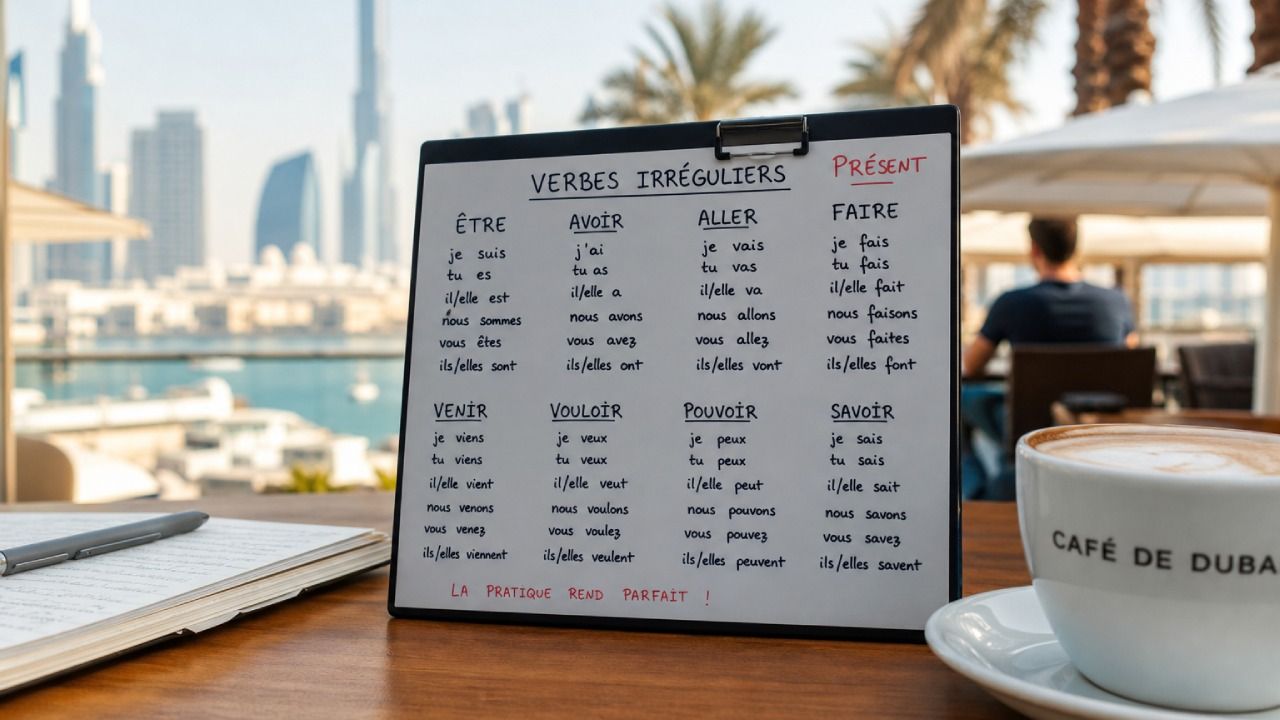
Irregular Verbs in French – Master the Most Common and Tricky Verbs
May 12, 2026Why irregular verbs are scary… but shouldn’t be!
Irregular verbs in French: 3 words that trip up 8 out of 10 beginners. But here’s the good news: just 10 irregular verbs account for 50% of all conversations in French.
If you live in Dubai or Abu Dhabi, you hear them every day: “Je suis au DIFC”, “Tu as une réunion ?”, “Nous allons au Mall”. “I’m at the DIFC,” “Do you have a meeting?” “We’re going to the mall.” You can’t order a coffee, sign a contract or enrol your children in school without them.
The problem is: they follow no logic whatsoever. Être, avoir, aller…(to be-to have-to go) Nothing to do with parler or finir.
What this article promises: to help you master the 12 most useful irregular verbs in the Emirates, in the present, past and future tenses. No heavy grammar. Just practical examples from your life in Dubai and tips to help you remember them in 10 minutes a day.
No need to learn everything at once. Let’s start with the essentials, together.
What is an irregular verb? And why are they so commonly used?
An irregular verb in French is simple: it doesn’t follow the rule. Regular -er verbs like ‘parler’ all follow the pattern ‘je parle, tu parles, il parle’. Easy. But ‘être’ gives ‘je suis, tu es, il est’. It’s completely different. You can’t guess them. You have to learn them by heart.
So why bother with them? Because they are the oldest verbs… and therefore the most commonly used in the language. Think of the roads in Dubai: Sheikh Zayed Road is old, full of ‘irregular’ exits, but it’s the one everyone takes every day. “être”, “avoir" , “aller” (To be, to have, to go): these are the “motorways” of French. You’ll come across them in every other sentence.
In reality, there are only 30 to 40 truly irregular verbs you need to know. And to live in the Emirates, 12 are enough for 80% of situations.
Table: Regular vs Irregular, the difference in 3 seconds
| Verbe régulier -er | Verbe irrégulier | Traduction EN | Traduction AR |
|---|---|---|---|
| Parler | Être | To be | أن يكون |
| Travailler | Avoir | To have | أن يملك |
| Habiter | Aller | To go | أن يذهب |
| Écouter | Faire | To do / make | أن يفعل |
Golden rule: The more a verb is used, the more likely it is to be irregular. It’s frustrating at first, but it’s also what will help you speak French quickly in the UAE.
The 12 Essential Irregular Verbs in the Present Tense for Living in the UAE
In Dubai or Abu Dhabi, 90% of your everyday sentences revolve around 12 irregular verbs. Learning them in the present tense will help you navigate work, school, social outings, and administrative tasks. You don’t need to know them all—start with these.
How did we choose them? These are the verbs expats use every day at the DIFC, the Marina, school, or the supermarket. They cover who you are, what you have, where you’re going, and what you need to do.
Here are your 12 survival verbs, with conjugations for “I, you, we” + UAE examples:
- Être : to be . Je suis consultant à Dubai Media City. Tu es d’où ? Nous sommes expatriés. I’m a consultant in Dubai Media City. Where are you from? We’re expats.
- Avoir : to have. J’ai une réunion à 15h. Tu as ton Emirates ID ? Nous avons deux enfants. I have a meeting at 3 p.m. Do you have your Emirates ID? We have two children.
- Aller : to go . Je vais au Mall of the Emirates. Tu vas à la plage ? Nous allons à Yas Island. I’m going to the Mall of the Emirates. Are you going to the beach? We’re going to Yas Island.
- Faire : to do. Je fais du télétravail. Tu fais quoi ce soir ? Nous faisons les courses à Carrefour. I’m working from home. What are you doing tonight? We’re doing the grocery shopping at Carrefour.
- Dire : to say. Je dis toujours la vérité. Tu dis ça au RH ? Nous disons merci / shukran. I always tell the truth. Are you going to tell HR that? We say thank you / shukran.
- Pouvoir : Can. Je peux payer en AED ? Tu peux m’aider ? Nous pouvons signer demain. Can I pay in AED? Can you help me? We can sign tomorrow.
- Vouloir :Want. Je veux un café. Tu veux visiter le Louvre Abu Dhabi ? Nous voulons changer d’appartement. I want a coffee. Do you want to visit the Louvre Abu Dhabi? We want to move to a new apartment.
- Venir : Come. Je viens du Canada. Tu viens à la réunion ? Nous venons d’arriver aux UAE. I’m from Canada. Are you coming to the meeting? We just arrived in the UAE.
- Voir : See. Je vois le Burj Khalifa du bureau. Tu vois l’email ? Nous voyons des amis ce weekend.Je vois le Burj Khalifa du bureau. Tu vois l’email ? Nous voyons des amis ce weekend.
- Prendre : Take. Je prends le métro ligne rouge. Tu prends un taxi ? Nous prenons un vol pour Paris. I’m taking the red metro line. Are you taking a taxi? We’re taking a flight to Paris.
- Savoir : to know. Je sais parler anglais. Tu sais où est la clinique ? Nous savons que c’est important. I know how to speak English. Do you know where the clinic is? We know it’s important.
- Devoir :to Have to Je dois renouveler mon visa. Tu dois être à l’heure. Nous devons partir tôt.I have to renew my visa. You have to be on time. We have to leave early.
The Present Perfect Tense: No More Panic Over “être” and “avoir”
The present perfect tense intimidates 90% of beginners. Good news: in the Emirates, you only need 2 auxiliary verbs and 12 past participles to talk about your day, your weekend, or your career.
10-second reminder: Present perfect = the present form of the auxiliary verb “to be” or “to have” + the past participle of the verb.
Which verbs take “to be”? Remember DR MRS VANDERTRAMP. Of our 12 verbs, only 2 are affected: “to go” and “to come.” All the others take “to have.”
Table: Your 12 verbs in the present perfect
| Verbe | Auxiliaire | Participe passé | Exemple UAE |
|---|---|---|---|
| Être | Avoir | Été | J’ai été en retard à cause de Sheikh Zayed Road. |
| Avoir | Avoir | Eu | Nous avons eu la résidence hier. |
| Aller | Être | Allé(e) | Je suis allé(e) au Global Village. |
| Faire | Avoir | Fait | Tu as fait le check-in à l’hôtel ? |
| Dire | Avoir | Dit | Il a dit que le contrat arrive demain. |
| Pouvoir | Avoir | Pu | Je n’ai pas pu venir à la réunion. |
| Vouloir | Avoir | Voulu | On a voulu visiter Hatta Dam. |
| Venir | Être | Venu(e) | Mes parents sont venus pour les fêtes. |
| Voir | Avoir | Vu | J’ai vu ton message WhatsApp. |
| Prendre | Avoir | Pris | Nous avons pris le métro jusqu’à Business Bay. |
| Savoir | Avoir | Su | Tu as su pour la nouvelle loi ? |
| Devoir | Avoir | Dû | J’ai dû payer le salik. |
Watch out for trap #1 in the UAE: j’ai allé(e) ❌ → Je suis allé(e)✅. With “être,” you agree the verb with the subject: Elle est allée, Nous sommes allés
Mini-exercise: Your turn! Fill in the blanks with the correct auxiliary verb.
- Hier, je ___ être à l’ambassade. → J’ai été
- Samedi, nous ___ aller à Abu Dhabi. → Nous sommes allés
- Tu ___ faire le visa ? → Tu as fait
Goal: Describe your weekend in 3 sentences. Example: “Je suis allé à La Mer. J’ai vu le coucher de soleil. Nous avons fait un resto “ That’s it. The past tense is a wrap.
The Simple Future: The 5 Irregular Verbs That Make All the Difference in Spoken French
In the Emirates, everything is planned: brunch at JBR, a visa renewal, a meeting at the DIFC. To talk about your plans, you’ll need the simple future. Good news: just 5 irregular verbs cover 90% of the cases.
Why not use the near future “je vais + infinitive”? Because in spoken English, native speakers use the simple future to sound professional and natural:“J’irai à Abu Dhabi vs Je vais aller à Abu Dhabi”. “I will go to Abu Dhabi” vs. “I’m going to Abu Dhabi.” It’s shorter and more natural.
The 5 irregular verb roots you need to know by heart:
| Verbe | Root au futur | Je | Tu | Nous | Exemple UAE |
|---|---|---|---|---|---|
| Être | ser- | je serai | tu seras | nous serons | Je serai au bureau dimanche. |
| Avoir | aur- | j’aurai | tu auras | nous aurons | Nous aurons le visa next week. |
| Aller | ir- | j’irai | tu iras | nous irons | J’irai au Global Village ce soir. |
| Faire | fer- | je ferai | tu feras | nous ferons | Tu feras la demande en ligne ? |
| Vouloir | voudr- | je voudrai | tu voudras | nous voudrons | Ils voudront visiter Burj Khalifa. |
Tip for beginners: Just learn “I” and “we.” That covers 70% of what you need: I’ll be late. We’ll go to the beach.
3 UAE scenarios:
- At work: Next week, I’ll have a presentation in Downtown.
- With family: This weekend, we’ll go to Ferrari World Abu Dhabi.
- Admin: I’ll renew the lease tomorrow.
Quick tip: Stuck on “nous ferons”? Say “on va faire.” The French do the same in spoken French. The important thing is to communicate.
Goal: This week, use one sentence in the simple future tense every day.” Demain, j’irai à la gym”. Let’s get started.
The 3 Mistakes That Hold Back 80% of Expat Learners
You know your verbs, but you’re struggling with speaking in Dubai? That’s normal. Here are the 3 mistakes I correct every week with my expat students. Avoiding them will help you speak twice as fast.
- Confusing “je vais” (present) and “j’irai” (future) I’m going to the beach tomorrow ❌ → I’ll go to the beach tomorrow ✅ Why you do it: In English, “I’m going” = near future. In French, “je vais” = now. UAE Tip: Tomorrow = future → “irai.” Today = present → “vais.” Today I’m going to the DIFC. Tomorrow I’ll go to Abu Dhabi.
- “J’ai allé” instead of “Je suis allé” / “J’ai allé au Mall” ❌ → “Je suis allé au Mall” ✅ Why you do this: 90% of verbs take “avoir.” It makes sense to say “j’ai allé.” Mnemonic tip: “Home” movement verbs take “être”: aller, venir, arriver, partir, rester. Think “I’m going home” = “être.” I came home from work.
- The killer pronunciation: “ils font” vs. “ils sont” / “Ils font” /fɔ̃/ and “ils sont” /sɔ̃/ sound alike to an English speaker. Why it’s a problem: “Ils font la queue” vs. “Ils sont la queue” 😅
Tip: “Font” = mouth opens like for “fountain.” “Son” = mouth closed like for “sound.” Practice: They play sports. They are strong.
Challenge: This week, record yourself on WhatsApp saying “Tomorrow, I’ll go to the beach.” “Yesterday, I went to the restaurant.” Listen back. You’ll hear your progress.
Go the extra mile: free resources and exercises
Mastering French irregular verbs is like learning to drive in Dubai: you have to practice. Here are your free tools to help you move from theory to muscle memory.
- Downloadable cheat sheet: “My 12 Verbs x 3 Tenses” in PDF format, specially designed for UAE expats with examples like DIFC, visa, and Mall. Print it out and stick it on the fridge.
- Interactive exercise websites: Le Point du FLE: “être/avoir/aller” exercises (A1-A2 level) TV5Monde Langue Française: videos + real-life context quizzes Conjuguemos: timed game to memorize “faire,” “pouvoir,” and “vouloir”
- YouTube for speaking practice: Français avec Pierre “Irregular Verbs Without Stress” and InnerFrench for B1 level. Listen for 10 minutes on the red metro line.
- Local practice: The Alliance Française Dubai and AF Abu Dhabi offer “conjugation workshops” on Saturdays. 1 hour, zero pressure, 100% practice among expats.
Test yourself now: 5-minute quiz “Present vs. Past Tense” [Take the quiz]. You’ll get your score + the verbs to review.
Your Next Step in Speaking French in the Emirates
Memorizing irregular verbs in French isn’t rocket science. It’s 12 verbs, 3 tenses, and situations you’re already experiencing in Dubai or Abu Dhabi.
Today, “être,” “avoir,” and “aller” seem irregular to you. In a month, you’ll use them without thinking at the office, at school, or at the RTA. It’s like driving on Sheikh Zayed Road: at first it’s stressful, but then it becomes second nature.
Your immediate action plan:
- Choose 4 verbs this week: to be, to have, to go, to do
- Make 1 sentence per day in the present, past, and future tenses
- Try the Post-it method or WhatsApp audio
French in the UAE isn’t an exam. It’s a tool for your life. Every “I can,” “I did,” and “I will” opens a door for you: a job, a friendship, a stress-free visa.
So, which verb is stumping you the most today? Share it in the comments. I’ll give you a personal tip to help you get past it.
And so you don’t forget anything, download your 30-day “UAE Expats Special” study plan: 1 verb/day, Dubai examples, quiz included.
It’s up to you. When do we start?
FAQ about irregular verbs in the passé simple
What are the most common irregular verbs?
In French, 12 irregular verbs account for 80% of the sentences you’ll use in Dubai: être, avoir, aller, faire, dire, pouvoir, vouloir, venir, voir, prendre, savoir, devoir.
Examples from the UAE: I’m a consultant at the DIFC. Do you have your Emirates ID? We’re going to the Mall of the Emirates. I need to renew my visa.
Start with these four: être, avoir, aller, faire. With these, you can already handle work, school, and administrative tasks.
How are irregular verbs different from regular verbs?
Regular verbs follow a fixed pattern. Example (-er): parler → je parle, tu parles, nous parlons. The root “parl-” never changes.
Irregular verbs change completely: être → je suis, tu es, nous sommes. There’s no logic to it; you have to memorize them.
Why? They are the oldest and most commonly used verbs. Like Sheikh Zayed Road in Dubai: full of exceptions, but essential every day.
How can I memorize irregular verb conjugations?
3 methods tested by expats in Dubai:
- The 1-1-10 rule: 1 verb, 1 tense, 10 min/day. Monday = present tense only.
- Group the twins: venir/tenir → je viens, je tiens. Pouvoir/vouloir → je peux, je veux. You learn 1, you remember 2.
- UAE context required: Build your sentences around your life: I’m going to the metro. I went to Yas Mall. I’ll go to Abu Dhabi.
Bonus: 10-second WhatsApp audio daily. Repetition + real-life context = memorization in 3 weeks.
Don't miss a beat!
New moves, motivation, and classes delivered to your inbox.
We hate SPAM. We will never sell your information, for any reason.
