
French Filler Words: 20+ Common
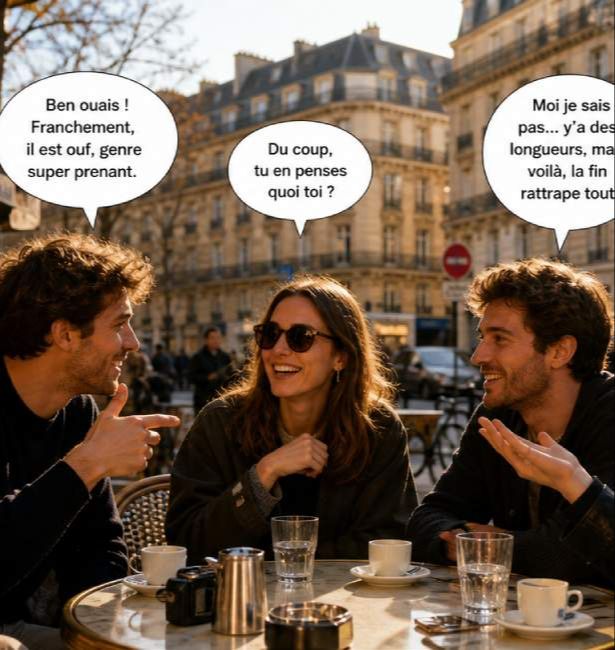
Learning French is about much more than memorizing grammar rules and vocabulary. If you've ever listened to native French speakers chatting in a café, at work, or on the streets of Paris, you've probably noticed they often use small words and expressions like euh, ben, alors, and quoi. These are known as French filler words.
Although they don't usually add much meaning to a sentence, they play an important role in making conversations sound smooth, natural, and authentic. Filler words help speakers pause while thinking, express emotions, soften statements, or keep a conversation flowing.
For expatriates living in the United Arab Emirates, learning these expressions can make everyday interactions with French-speaking colleagues, clients, or friends feel much more comfortable. Whether you're preparing for a business meeting, planning a trip to France, or simply hoping to sound more like a native speaker, understanding French filler words is a valuable step in your language journey.
In this guide, you'll discover the most common French filler words, learn exactly when to use them, hear how they're pronounced, and see plenty of real-life examples. By the end, you'll be ready to add these natural everyday french expressions to your own conversations with confidence.
What are French filler words ?
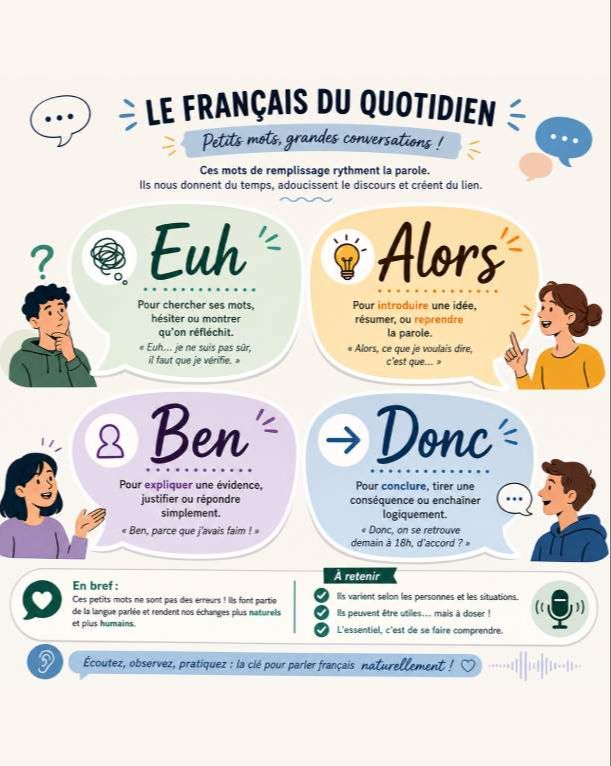
French filler words are short expressions that speakers use to organize their thoughts, hesitate, react, or connect ideas while speaking. English speakers do exactly the same thing with words like:
- "Um"
- "Well"
- "You know"
- "Actually"
- "So"
- "Like"
French speakers also rely on these verbal habits. Instead of sounding hesitant, they often make speech feel more natural and conversational.
For example:
English / French
"Well... I think it's a good idea." / "Alors... je pense que c'est une bonne idée."
Likewise:
English / French
"Um... I don't know." / "Euh... je ne sais pas."
Using a few filler words appropriately can instantly make your French sound less like a textbook and more like everyday conversation.
Why Learning French Filler Words Matters
Many learners focus on grammar, verb conjugations, and pronunciation. While these are essential, conversations don't always follow perfect textbook rules.
Native speakers naturally pause, hesitate, change direction, or emphasize ideas. Filler words help them do exactly that.
Here are some benefits of learning French filler words:
They make you sound more natural
Native speakers rarely speak in perfectly complete sentences without pausing. Using expressions like bon, alors, or eh bien helps your speech flow more naturally.
They buy you thinking time
Instead of falling silent while searching for vocabulary, you can comfortably say:
Euh...
This gives you a moment to think without interrupting the conversation.
They improve listening comprehension
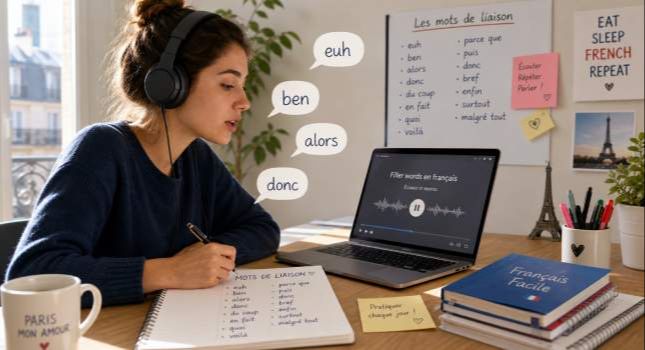
French films, podcasts, and everyday conversations are full of filler words. Once you recognize them, you'll understand native speakers much more easily.
They help you understand French culture
Many filler expressions also communicate emotions such as surprise, agreement, doubt, or politeness. Understanding these subtle meanings helps you communicate more effectively.
List of Essential French Filler Words and Expressions
Here are some of the most useful filler words you'll hear every day.
1. Euh...
Meaning: Um... / Uh...
Pronunciation IPA: /ø/
Easy pronunciation: uh (with rounded lips)
Example
Euh... je ne sais pas.
"Um... I don't know."
When to use it
Use euh whenever you're thinking before answering.
2. Alors
Meaning
- So...
- Well...
- Then...
Pronunciation
IPA: /a.lɔʁ/
Easy pronunciation: ah-LOR
Example
Alors, qu'est-ce qu'on fait ?
"So, what are we doing?"
Common situations
- Starting a conversation
- Changing topic
- Introducing an idea
- Asking a question
3. Ben
Meaning
Well...
This is an informal version of eh bien.
Pronunciation
IPA: /bɛ̃/
Easy pronunciation: beh(n)
Example:
Ben oui.
"Well, yes."
or
Ben non.
"Well, no."
You'll hear ben constantly in casual conversations among native speakers.
4. Bon
Meaning
Well...
Okay...
Right…
Although bon literally means "good," it often serves as a conversational transition.
Example:
Bon, on y va.
"Right, let's go."
Another example:
Bon... je vais réfléchir.
"Well... I'll think about it."
5. Eh bien
Meaning
Well…
This expression sounds slightly more formal than ben.
Example:
Eh bien, c'est intéressant.
"Well, that's interesting."
You'll often hear teachers, news presenters, and older speakers use it.
6. En fait
Meaning
Actually
In fact
IPA: /ɑ̃ fɛ/
Easy pronunciation: on FEHT
Example:
En fait, je préfère le café.
"Actually, I prefer coffee."
Use it when correcting yourself or introducing additional information.
7. Donc
So
Therefore
Example:
Donc, on commence ?
"So, shall we start?"
French speakers often use donc much more frequently than English speakers use "therefore."
8. Enfin
Meaning
Well...
Actually...
Anyway...
Finally (depending on context)
Example:
Enfin... ce n'est pas très grave.
"Well... it's not a big deal."
This versatile expression often softens what comes next.

Softening an opinion
Expressions like en fait or enfin make opinions sound more polite.
Instead of saying:
Tu as tort.
("You're wrong.")
A native speaker might say:
Enfin... je ne suis pas sûr.
("Well... I'm not sure.")
This creates a friendlier tone.
Reacting naturally
Small expressions make your responses feel authentic.
Examples include:
- Ben oui ! — Of course!
- Ben non ! — Of course not!
- Alors là ! — Wow! / Seriously!
- Bon... — Well then...
How to Use French Filler Words in Real Conversations
Learning vocabulary is one thing; using it naturally is another. The key is to understand the situations where native speakers insert filler words without even thinking. Pair these french expressions with the French filler words natives use between sentences to sound even more natural, with the French Method.
Starting a conversation
French speakers often begin with alors or bon.
Example
A: Alors, comment ça va ?
B: Très bien, merci.
Taking time to think
Instead of remaining silent, simply say:
Euh...
This keeps the conversation flowing while you organize your thoughts.
Example
A: Quel est ton plat préféré ?
B: Euh... je dirais la raclette.
Changing the topic
Use:
- Bon...
- Alors...
- Donc...
Example:
Bon, parlons du projet.
"Right, let's talk about the project."
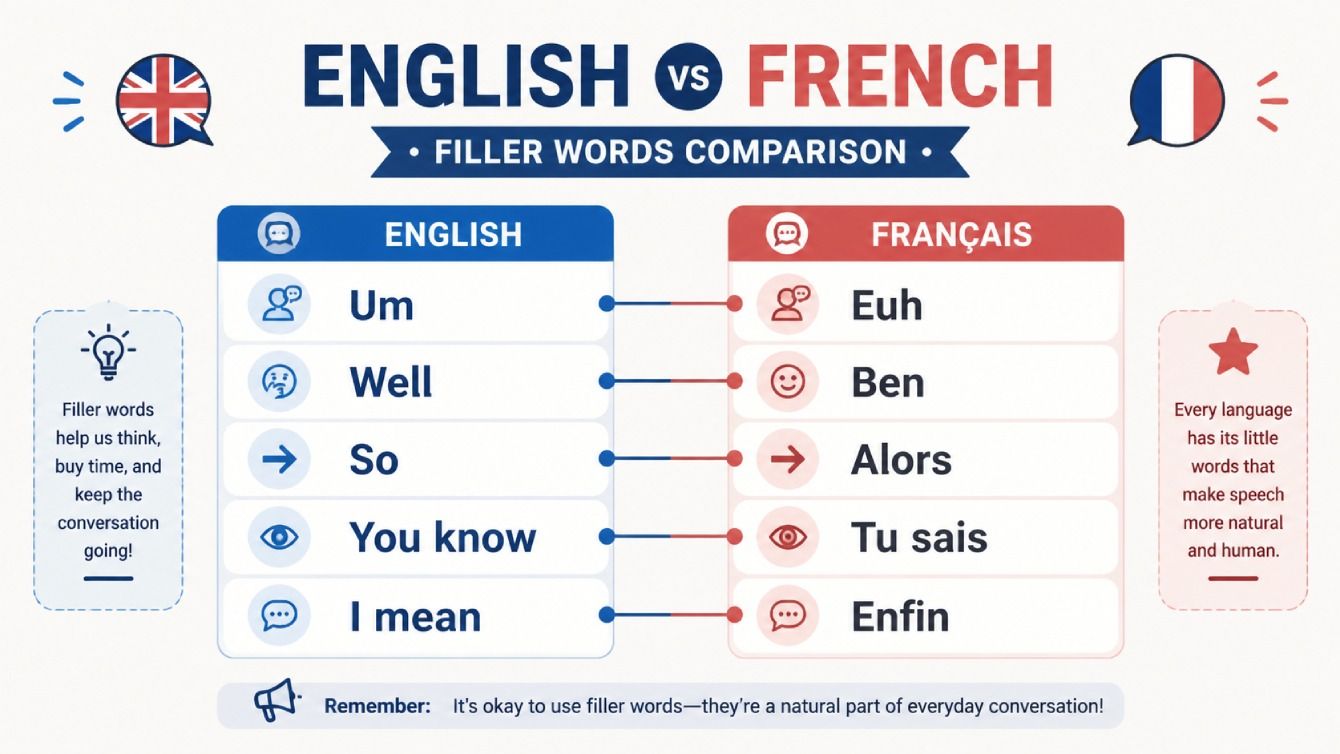
French Filler Words vs English Filler Words
If you're an English speaker, many French filler words will feel surprisingly familiar because they serve the same conversational purpose. However, direct translations are not always possible, and understanding the differences will help you sound more natural.
| English filler word | French equivalent | Typical use |
| Um... | Euh... | Thinking before speaking |
| Well... | Ben, Bon, Eh bien | Introducing an idea or response |
| So... | Alors, Donc | Starting or connecting ideas |
| Actually... | En fait | Correcting or clarifying information |
| Anyway... | Enfin, Bref | Changing direction or concluding |
One important difference is that French speakers generally use filler words more frequently in casual conversation than English speakers. If you watch French interviews or listen to podcasts, you'll hear expressions like alors, donc, and ben repeated naturally throughout the discussion.
The goal isn't to use these words constantly but to sprinkle them into your speech where they feel appropriate. Over time, they'll become a natural part of how you express yourself in French.
H2 Spoken French vs Written French: When to Use Filler Words
One of the biggest mistakes French learners make is using spoken expressions in formal writing. While filler words are an essential part of everyday conversation, they rarely belong in professional emails, academic essays, or official documents.
Understanding the difference between spoken French and written French will help you communicate more naturally in every situation.
When to Use Filler Words
Filler words are perfectly appropriate in:
- Everyday conversations
- Speaking with friends and family
- Casual workplace discussions
- Phone calls
- Language exchange sessions
- Interviews and podcasts
- Informal presentations
For example:
Alors, on commence ?
"So, shall we begin?"
Or:
Euh… je crois que oui.
"Um… I think so."
These expressions make speech sound relaxed and spontaneous.
When to Avoid Them
In contrast, avoid filler words in:
- Formal emails
- Job application letters
- Academic assignments
- Business reports
- Official presentations
- Legal or administrative documents
Instead of writing:
Bon, je voudrais vous informer que…
Write:
Je souhaiterais vous informer que…
The second version sounds much more professional.
Finding the Right Balance
Even in conversation, moderation is important. Native speakers use filler words naturally, but excessive repetition can make anyone sound uncertain.
For example:
❌ Euh… alors… ben… euh… donc…
This sounds hesitant.
Instead:
✅ Alors, je pense que nous pouvons commencer.
A single well-placed filler word sounds confident and authentic.
More Useful French Filler Words You'll Hear Every Day
Beyond the basic expressions covered earlier, native speakers rely on many other filler words that add personality and rhythm to conversations.
Bref
Meaning
- Anyway
- In short
- Long story short
Pronunciation
IPA: /bʁɛf/
Easy pronunciation: brehf
Example
Bref, c'était une excellente journée.
"In short, it was a great day."
Use bref to summarize a story or move quickly to the conclusion.
Du coup
One of the most common modern French filler expressions.
Meaning
- So
- As a result
- Then
Native speakers use it constantly, especially younger generations.
Example
Il pleuvait. Du coup, on est restés à la maison.
"It was raining, so we stayed at home."
Don't be surprised if you hear du coup several times in a single conversation.
Genre
Among younger speakers, genre is extremely common.
Meaning
- Like...
Similar to the English filler word "like."
Example
C'était genre incroyable.
"It was, like, incredible."
Use it sparingly, as overusing it can sound immature.
Bah
A close relative of ben, bah often expresses surprise, resignation, or an obvious answer.
Examples
Bah oui !
"Well, yes!"
Bah non !
"Of course not!"
You'll hear this frequently in informal conversations.
Voilà
Literally meaning "there it is," voilà has many conversational uses.
It can mean:
- That's it.
- There you go.
- Well...
- So...
Examples
Voilà !
"There you go!"
Voilà pourquoi j'apprends le français.
"That's why I'm learning French."
Hein ?
Meaning
- Huh?
- Right?
- Isn't it?
It often invites agreement or asks someone to repeat something.
Examples
C'est magnifique, hein ?
"It's beautiful, isn't it?"
Or:
Hein ? Je n'ai pas entendu.
"Huh? I didn't hear."
Quoi
Although quoi literally means "what," it is frequently placed at the end of informal sentences.
Example
C'est compliqué, quoi.
"It's complicated, you know."
It softens statements and makes them sound more conversational.
Tu vois
Meaning
- You see
- You know what I mean?
Example
C'est difficile, tu vois ?
"It's difficult, you know?"
This expression checks whether the listener is following the conversation.
Examples of French Filler Words in Real-Life Conversations
Let's see how these expressions appear naturally in everyday situations.
Conversation at Work
Marie: Bonjour ! Alors, comment va le projet ?
Paul: Euh… ça avance bien.
Marie: Bon, parfait.
Paul: Du coup, on peut présenter les résultats demain.
At a Café
Serveur: Vous désirez autre chose ?
Client: Euh… un café, s'il vous plaît.
Serveur: Très bien.
Meeting Friends
A: Alors, tu viens ce soir ?
B: Ben oui !
A: Super !
Talking About a Weekend
A: Comment était ton week-end ?
B: Eh bien… il faisait très beau. Du coup, nous sommes allés à la plage. Enfin, seulement le samedi parce qu'il a plu dimanche. Bref, c'était très agréable.
Notice how several filler words naturally connect the story without making it sound repetitive.
Correcting Yourself
En fait, je voulais dire mardi.
"Actually, I meant Tuesday."
Ending a Story
Bref, tout s'est bien passé.
"Anyway, everything went well."
Pronunciation Tips for French Filler Words
Correct pronunciation helps these expressions sound effortless.
Here are a few practical tips.
Round Your Lips for Euh
Unlike the English "uh," the French euh uses rounded lips.
Practice by saying the French vowel in deux before shortening it into euh.
Pay Attention to Intonation
Many filler words change meaning depending on your tone.
Compare:
Alors ?
(asking a question)
versus
Alors...
(introducing a story)
The melody of your voice is just as important as the words themselves.
Don't Pronounce Every Letter
French naturally links sounds together.
Instead of saying:
A-lors
Listen for the smoother pronunciation:
Alors
Native speech flows continuously.
Listen Before You Copy
One of the fastest ways to improve pronunciation is through regular listening.
Excellent resources include:
- French podcasts for learners
- French news broadcasts
- TV series with subtitles
- Language-learning apps featuring native speakers
- Online pronunciation dictionaries with audio recordings
Listening repeatedly helps you imitate rhythm, stress, and natural pauses.
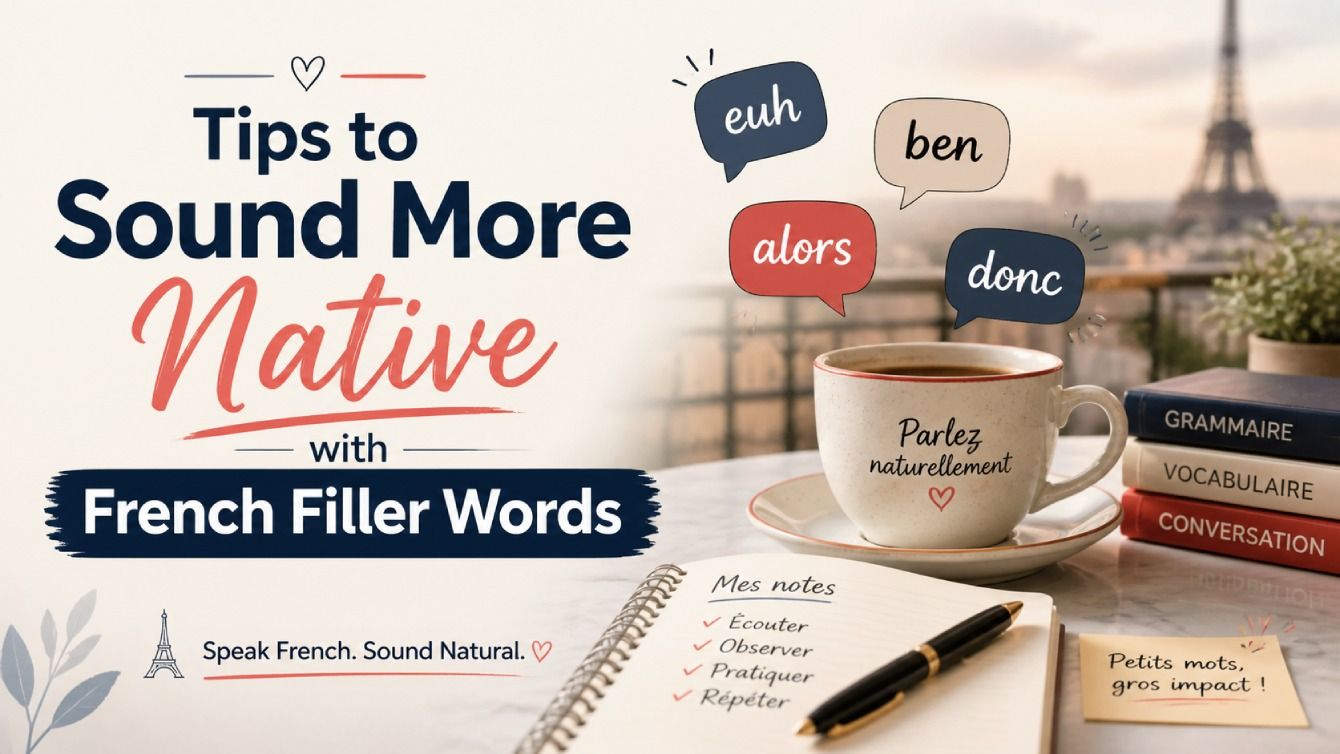
Tips to Sound More Native with French Filler Words
Using filler words correctly isn't about adding as many as possible. It's about sounding relaxed and authentic. Practising with a tutor during private French courses is the fastest way to make fillers automatic
Start Small
Choose just three expressions to begin with:
- Alors
- Euh
- Bon
Use them consistently until they become automatic.
Learn Through Listening
Whenever you watch French videos, pay attention to:
- where speakers pause
- how often they use alors
- when they say ben
- how conversations flow naturally
Soon you'll begin noticing patterns.
Practice Speaking Out Loud
Read dialogues aloud and intentionally include filler words.
For example:
Alors… aujourd'hui, je vais parler de mon voyage.
Repeating complete sentences helps build fluency.
Record Yourself
Listening to your own speech allows you to identify moments where conversations feel too rigid or overly rehearsed.
Adding a few natural filler expressions can make your French sound much smoother.
Don't Overuse Them
Beginners sometimes try to imitate native speakers by inserting filler words into every sentence.
Instead of sounding fluent, this can become distracting.
Aim for natural variety.
Match the Situation
Remember that expressions such as genre, quoi, and bah are very informal.
For professional conversations, prefer:
- Alors
- Eh bien
- En fait
- Donc
These expressions are appropriate in most settings, including meetings and conversations with colleagues.
By adapting your language to the situation, you'll sound more confident and culturally aware—an important skill for expatriates using French in international workplaces, including those in the UAE.
Frequently Asked Questions About French Filler Words
What are French filler words?
Why do French people use so many filler words?
Should beginners learn French filler words?
Are French filler words used in formal writing?
Which French filler words should I learn first?
How can I improve my pronunciation of French filler words?
Common Mistakes to Avoid
As you begin using French filler words, keep these common pitfalls in mind.
Using Too Many Filler Words
Native speakers use filler words naturally—not constantly.
For example:
❌ Euh... alors... ben... donc... euh...
This can make your speech sound hesitant.
Instead, choose one appropriate filler word and continue your sentence naturally.
Using Informal Expressions in Professional Situations
Expressions like genre, quoi, and bah are common among friends but may sound too casual during business meetings or formal conversations.
If you're speaking with colleagues, clients, or teachers, safer choices include:
- Alors
- En fait
- Donc
- Eh bien
These expressions sound natural while remaining professional.
Translating English Filler Words Directly
Not every English filler word has an exact French equivalent.
For instance, English speakers often use "like" very frequently. Although genre can sometimes serve a similar purpose, it shouldn't replace every instance of "like."
The best approach is to learn each French expression in context rather than translating word for word.
Forgetting About Intonation
A filler word is only part of the message. Native French speakers also rely on tone, pauses, and facial expressions.
For example:
- Alors ? (expecting an answer)
- Alors... (introducing a new idea)
Practising complete sentences aloud will help you master these subtle differences.
Final Thoughts
French filler words may seem small, but they have a big impact on how natural your French sounds. By incorporating expressions like euh, alors, ben, bon, en fait, and donc into your conversations, you'll begin to speak with greater confidence and ease.
Remember that fluency isn't about speaking quickly or using difficult vocabulary. It's about communicating comfortably and naturally. Native speakers don't expect every sentence to be perfect—they appreciate conversations that flow smoothly and feel authentic.
The best way to master french pronunciation and filler words is through regular exposure and practice. Listen to French podcasts during your commute, watch French films or television series, repeat dialogues aloud, and don't be afraid to use these expressions in everyday conversations. Over time, they'll become a natural part of your spoken French.
Whether you're living in the United Arab Emirates, preparing for a trip to a French-speaking country, or simply learning French for personal or professional growth, these small expressions will help you sound more confident, understand native speakers more easily, and enjoy richer conversations.
Take Your French Speaking Skills to the Next Level
Learning vocabulary is only the beginning. The real progress comes from practising with experienced teachers who can help you develop natural pronunciation, build confidence, and use everyday expressions correctly.
At French Tuitions, we specialize in helping expatriates and international learners across Dubai and the UAE achieve real conversational fluency. Our personalised French lessons are designed for beginners, intermediate learners, children, adults, and professionals who want practical language skills they can use every day.
Whether you're preparing for an exam, relocating to a French-speaking country, advancing your career, or simply learning for pleasure, our experienced native and bilingual teachers provide tailored lessons that match your goals and learning style.
Ready to sound more like a native speaker? Contact French Tuitions today to discover our personalised French courses and start speaking French with confidence.
